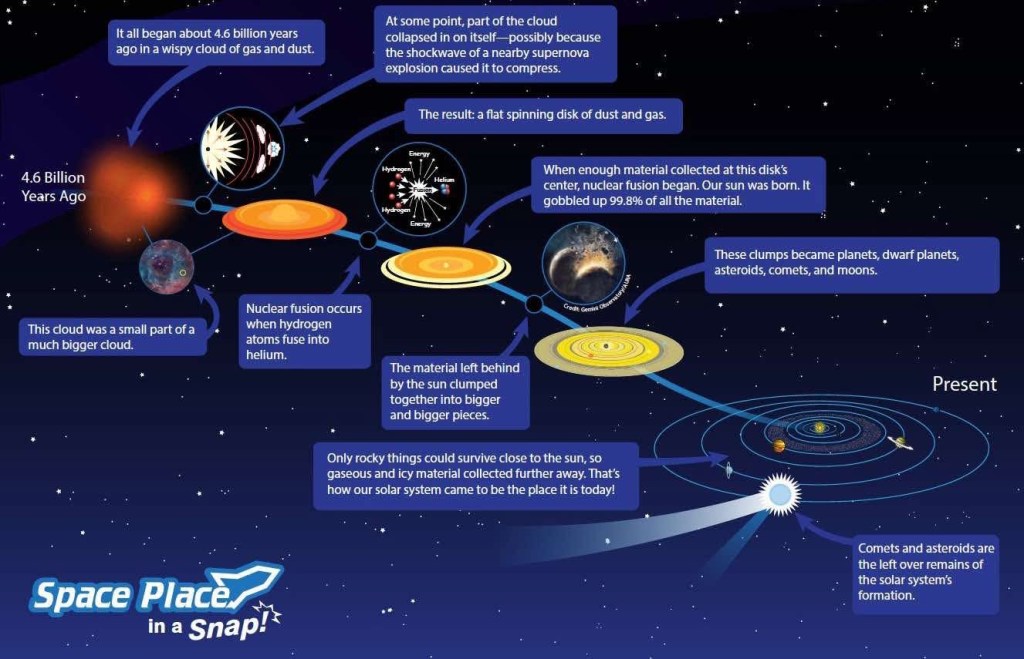
About 4.6 billion years ago, our solar system began as part of a vast cloud of gas and dust floating in space. Over time, part of this cloud collapsed in on itself, possibly triggered by the shockwave of a nearby supernova explosion. This collapse formed a flat, spinning disk of dust and gas. At its center, nuclear fusion ignited as hydrogen atoms fused into helium, giving birth to our Sun, which captured 99.8% of the material. The leftover dust and gas clumped together into larger and larger bodies, forming planets, moons, dwarf planets, asteroids, and comets. Closer to the Sun, only rocky materials survived the heat, while gaseous and icy materials gathered farther away. Over billions of years, these processes shaped the solar system we live in today, with comets and asteroids serving as leftover building blocks from its ancient beginnings.

 ScienceAndDiscovery