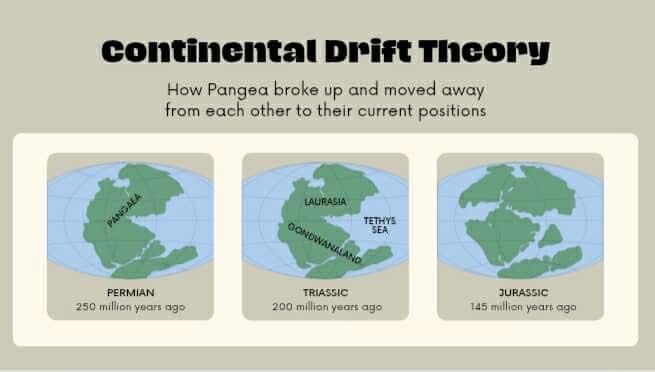
All land was gathered into Pangaea.
The surrounding ocean was called Panthalassa, covering most of the Earth.
Pangaea stretched almost from the North Pole to the South Pole.
Life included early reptiles, amphibians, and forests that produced massive coal deposits we still mine today.
Earth’s climate was generally dry inside the supercontinent because the ocean was far away from many regions.Triassic Period (200 million years ago)
Pangaea began to crack and split into two supercontinents:
Laurasia in the north (future North America, Europe, and Asia).
Gondwanaland in the south (future South America, Africa, Antarctica, Australia, and India).
Between them formed the Tethys Sea.
This was also the time when the first dinosaurs and early mammals appeared.Jurassic Period (145 million years ago)
The continents drifted farther apart.
Gondwanaland started to break into smaller continents.
The early Atlantic Ocean began to open.
Dinosaurs thrived, and lush forests covered much of Earth.
Continental movement created new coastlines and ecosystems, shaping the evolution of life.FROM CRETACROUS TO PRESENT DAY
Cretaceous Period (65 million years ago)
The separation between continents became more distinct.
South America and Africa had completely split.
India broke away from Africa and began drifting north toward Asia, eventually colliding to form the Himalayas.
Australia began moving away from Antarctica.
The Atlantic Ocean widened even more.
This was the time of the last dinosaurs—until a mass extinction event (caused by a massive asteroid impact and volcanic eruptions) wiped them out about 66 million years ago.
Present Day
Continents are in the positions we recognize today: North America, South America, Africa, Europe, Asia, Australia, and Antarctica.
They are not fixed—continents are still drifting at a rate of about 2–5 centimeters per year.
For example, the Atlantic Ocean is expanding because North America and Europe are moving apart.
The Pacific Ocean is shrinking because its ocean floor is being pushed under surrounding plates (subduction).
Earth continues to reshape itself through earthquakes, volcanic eruptions, and mountain-building.A SIMPLE THEN AND NOW COMPARISON
Then (250 million years ago – Pangaea)
Wegener proposed that all continents were once joined as a supercontinent.
His idea was based on evidence like fossils, geology, and climate.
At the time, many scientists rejected him because he couldn’t explain the mechanism of movement.
Now (Present Day – Separated Continents)
We now know Wegener was correct.
Plate tectonics explains that Earth’s outer shell is divided into massive plates that float on the semi-molten mantle.
These plates move slowly due to convection currents inside Earth.
This movement causes earthquakes, volcanic eruptions, and the drifting of continents.
 ScienceAndDiscovery