The Continental Drift Theory was first proposed by Alfred Wegener in 1912. He suggested that all continents were once part of a giant landmass called Pangaea about 200–250 million years ago. Over time, this supercontinent broke apart, and the fragments slowly drifted to their current positions. At first, many scientists rejected Wegener’s theory because he could not explain the actual mechanism of movement, but today we know his evidence was very strong.
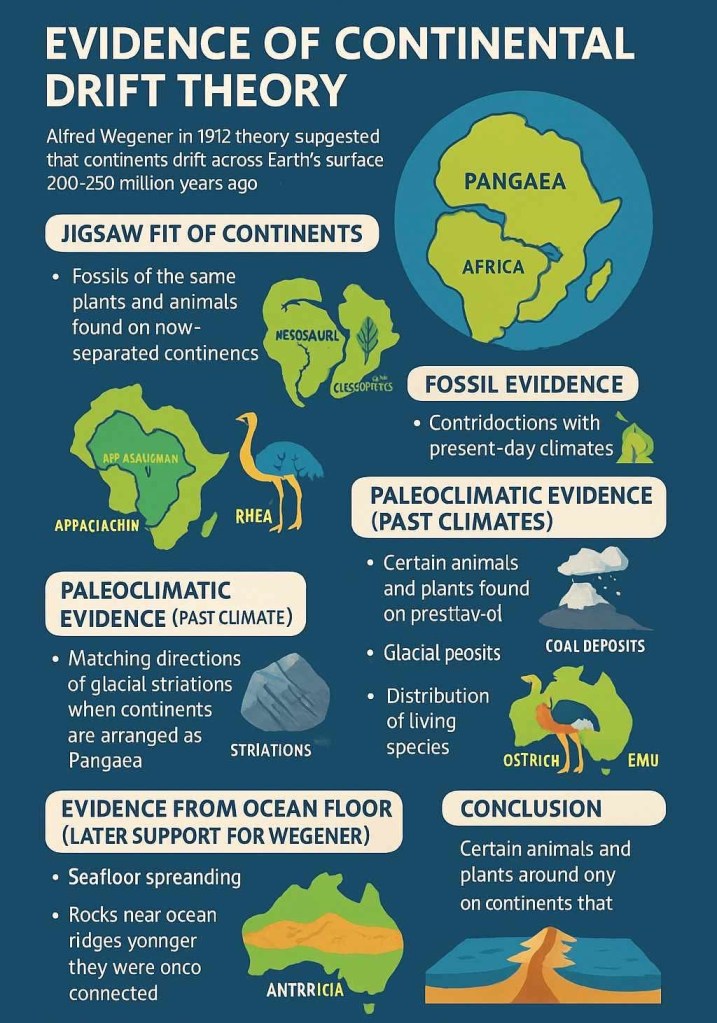
Here are the main pieces of evidence that support continental drift:
- Jigsaw Fit of Continents
The most striking evidence is the way continents appear to fit together like puzzle pieces.
The eastern coastline of South America matches closely with the western coastline of Africa.
Similarly, North America fits with Europe, and India fits into the curve of Asia.
This close fit suggests that the continents were once joined and later drifted apart.
Although erosion and sea level changes have slightly altered coastlines, the overall matching shape remains strong evidence.
- Fossil Evidence
Fossils of the same plants and animals have been discovered on continents that are now separated by wide oceans.
Examples:
Mesosaurus, a freshwater reptile, found in both Brazil (South America) and South Africa. Since it could not have swum across the salty Atlantic Ocean, the continents must once have been joined.
Glossopteris, a fern-like plant, whose fossils are found in Africa, South America, Antarctica, India, and Australia. This shows that these continents were once connected.
Lystrosaurus and Cynognathus, land reptiles, also provide strong proof, as their fossils are distributed across continents that were once linked.
- Similarity of Rocks and Mountain Ranges
Rocks and mountain chains on different continents show striking similarities:
The Appalachian Mountains in eastern North America match with the Caledonian Mountains of Scotland and Scandinavia.
Geological formations in Brazil are similar to those found in West Africa.
Such evidence suggests that these landmasses were once part of the same crustal block before drifting apart.
- Paleoclimatic Evidence (Past Climates)
Wegener also studied ancient climate patterns and found strong contradictions with present-day climates:
Glacial deposits (tillites) are found in present-day warm regions like South Africa, India, South America, and Australia. This shows that these regions were once near the South Pole.
Coal deposits, which form in warm, swampy climates, are found in Antarctica. This proves that Antarctica was once much closer to the equator and had a tropical climate.
These findings indicate that continents must have shifted to different climatic zones over millions of years.
- Glacial Striations and Rock Deposits
Glaciers leave behind scratch marks called striations on rocks.
The direction of these glacial striations on different continents matches perfectly when the continents are put together in the Pangaea arrangement.
For example, glacial deposits in India, Africa, Australia, and South America all point to a common ice sheet, proving they were once joined.
- Distribution of Living Species
Certain animals and plants are found only on continents that were once connected:
For example, the flightless bird Rhea in South America, Ostrich in Africa, and Emu in Australia are closely related species that evolved after the continents drifted apart.
This biogeographical evidence supports the idea that continents separated after species had already spread.
- Evidence from Ocean Floor (Later Support for Wegener)
Wegener lacked a clear mechanism, but later discoveries added strong support:
The study of the Mid-Atlantic Ridge revealed that new crust is formed by seafloor spreading.
Rocks near ocean ridges are younger than those farther away, showing continuous movement of plates.
Although this was discovered after Wegener’s time, it confirmed his theory of drifting continents.
 ScienceAndDiscovery