The solar system works as a balanced cosmic family the Sun provides energy and gravity, while planets, moons, and other celestial bodies move in harmony to sustain life and maintain order in space.
TITLE : 🌌 The Origin of the Solar System: From Dust to Planets 🌌
Around 4.6 billion years ago, before there were planets, moons, or even the Sun as we know it, our solar system was nothing more than a vast cloud of gas and dust drifting through the Milky Way. This cloud, called a solar nebula, was part of an even larger molecular cloud. Then, something set a chain of events in motion—possibly the shockwave from a nearby supernova explosion—that caused part of the nebula to collapse under its own gravity.
As the cloud contracted, it began to spin faster and flatten into a rotating disk. At its dense center, matter accumulated and grew hotter until temperatures and pressures were high enough for nuclear fusion to ignite. This was the birth of our Sun, which captured nearly 99.8% of the material in the disk.
But the story didn’t end there. The leftover dust and gas continued to collide, stick together, and clump into larger bodies called planetesimals. Over millions of years, these planetesimals grew into protoplanets through a process called accretion. The inner region of the disk, close to the Sun, was too hot for ices and gases to survive, so only rocky worlds—Mercury, Venus, Earth, and Mars—could form there. Farther out, where it was cold enough, gas and ice collected in abundance, giving rise to the giant planets—Jupiter, Saturn, Uranus, and Neptune.
Not everything was swept up into planets. Smaller remnants remained as asteroids, comets, and dwarf planets, preserving clues about the solar system’s early history. Even today, these leftovers—like the asteroids in the asteroid belt or comets from the distant Oort Cloud—serve as time capsules from that ancient era.
The formation of the solar system was not a calm process. The young Earth, for example, was bombarded by massive impacts, one of which is believed to have created our Moon. Over billions of years, gravitational interactions shaped stable planetary orbits, and the chaotic beginnings gradually gave way to the structured solar system we see today.
In the end, what began as a simple cloud of gas and dust became a family of worlds orbiting a star: a place of rocky planets, gas giants, icy comets, and moons of all shapes and sizes. Our solar system’s origin story is a reminder that from cosmic chaos, order—and even life—can emerge. 🌍✨
TITLE : A Chaotic Birthplace of Worlds

TITLE : The Birth of Our Solar System: From Cosmic Dust to Planets
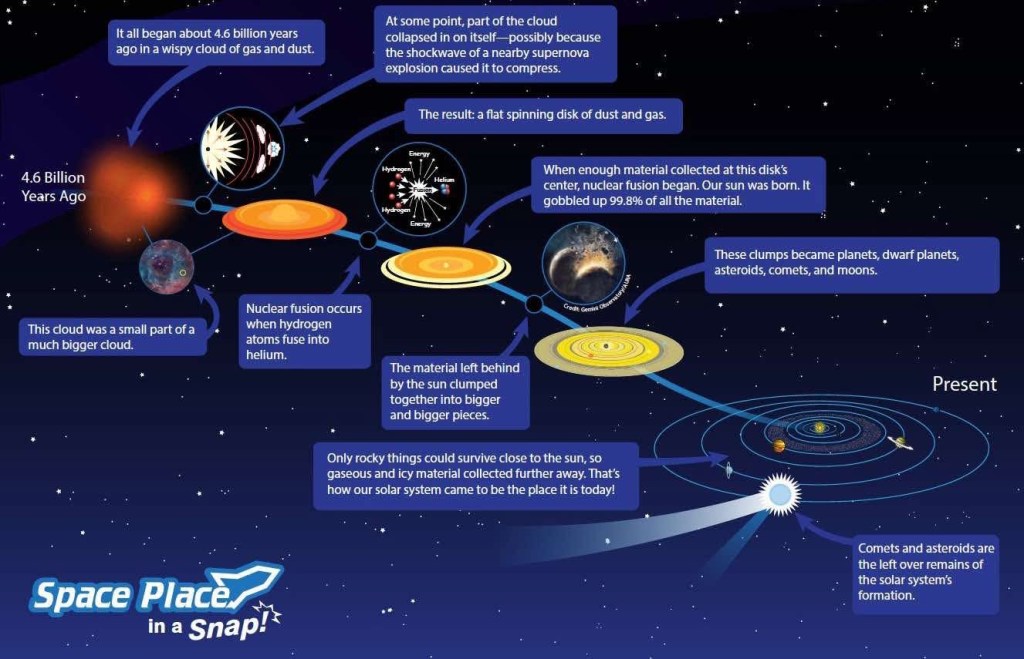
How did are solar system come to be?
incredible journey through the solar system
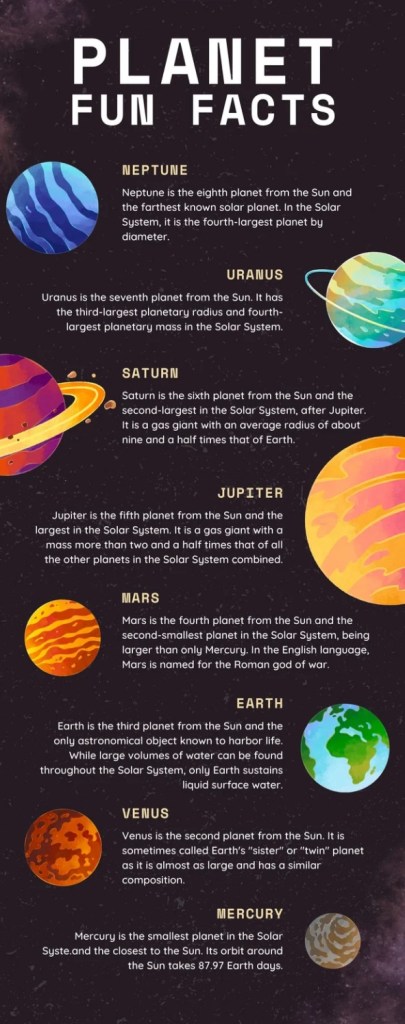
THE 8 PLANETS

🌌 THE SOLAR SYSTEM AND THE 8 PLANETS
The Solar System is a collection of celestial objects bound together by the Sun’s gravity. At the center is the Sun, a massive star that provides heat and light, making life on Earth possible. Surrounding the Sun are planets, moons, asteroids, comets, and dwarf planets.
The 8 planets in order from the Sun are:
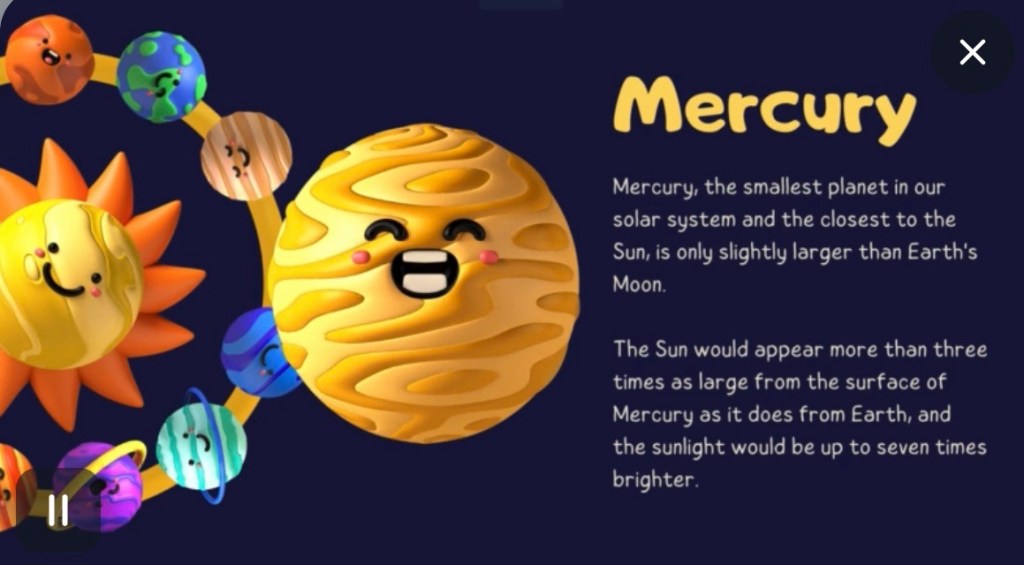
1. Mercury – The smallest planet, closest to the Sun, with extreme temperatures.
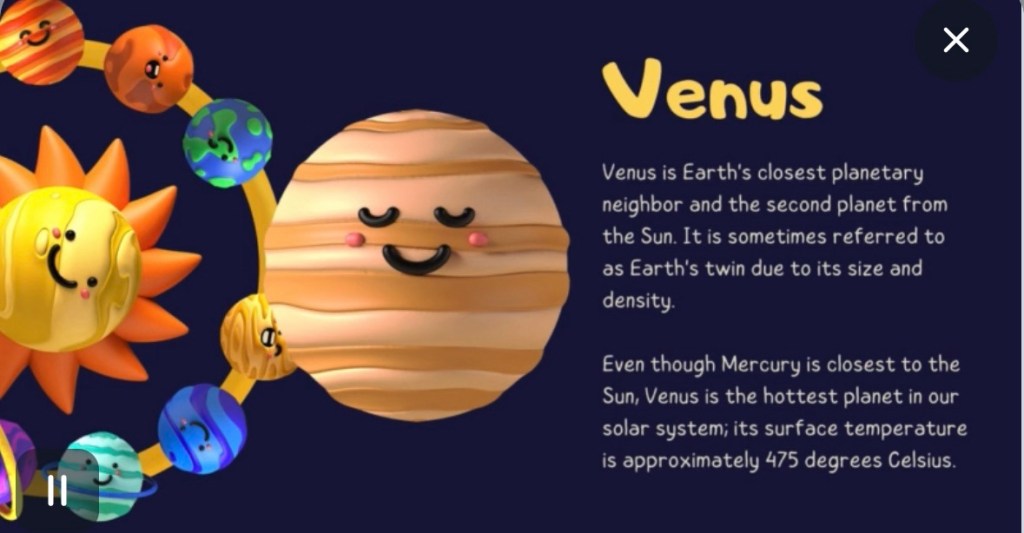
2. Venus – Known as Earth’s “twin” because of its size, but has a toxic atmosphere and extreme heat.
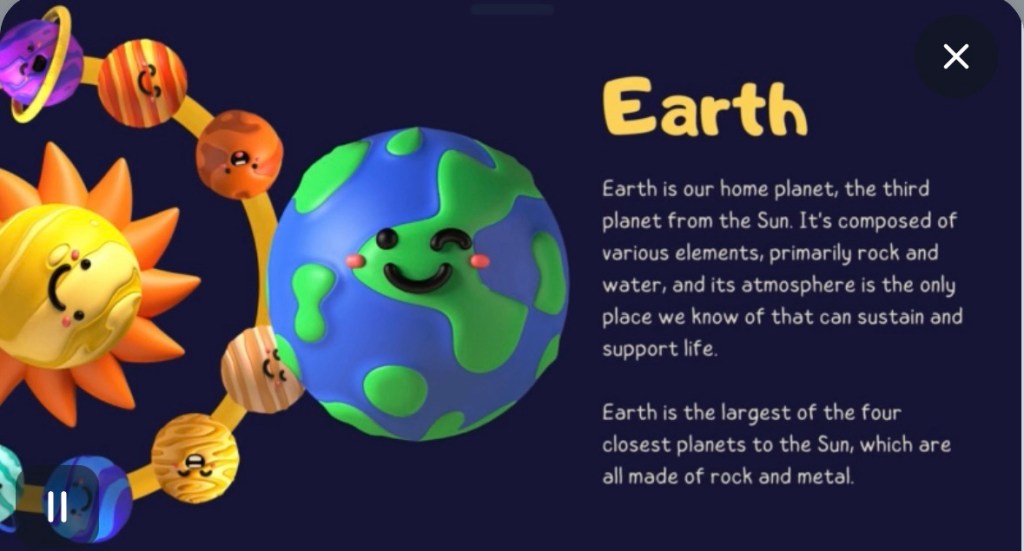
3. Earth – The only planet known to support life, with liquid water and a breathable atmosphere.
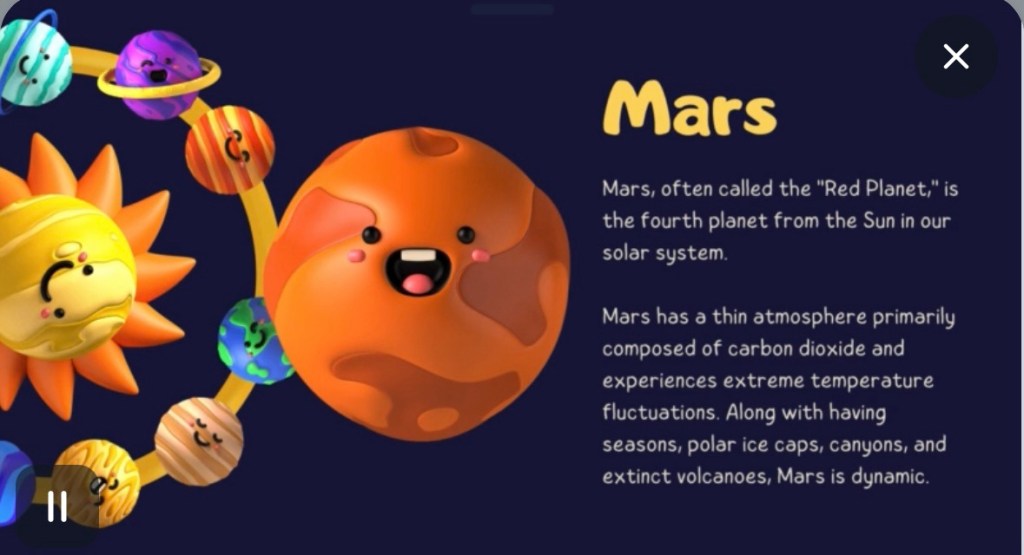
4. Mars – Called the “Red Planet,” it has the largest volcano and canyon in the Solar System.
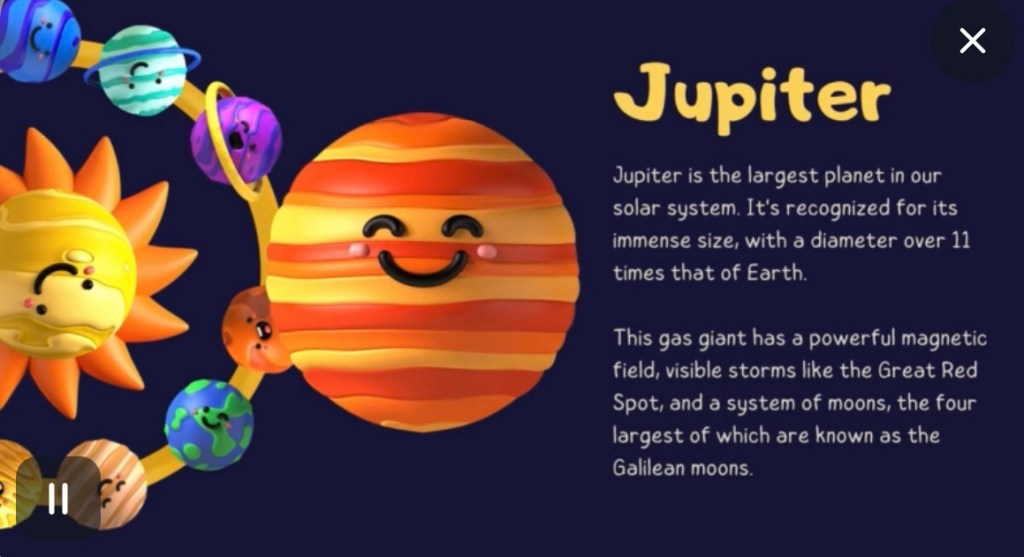
5. Jupiter – The largest planet, a gas giant with a famous Great Red Spot storm.
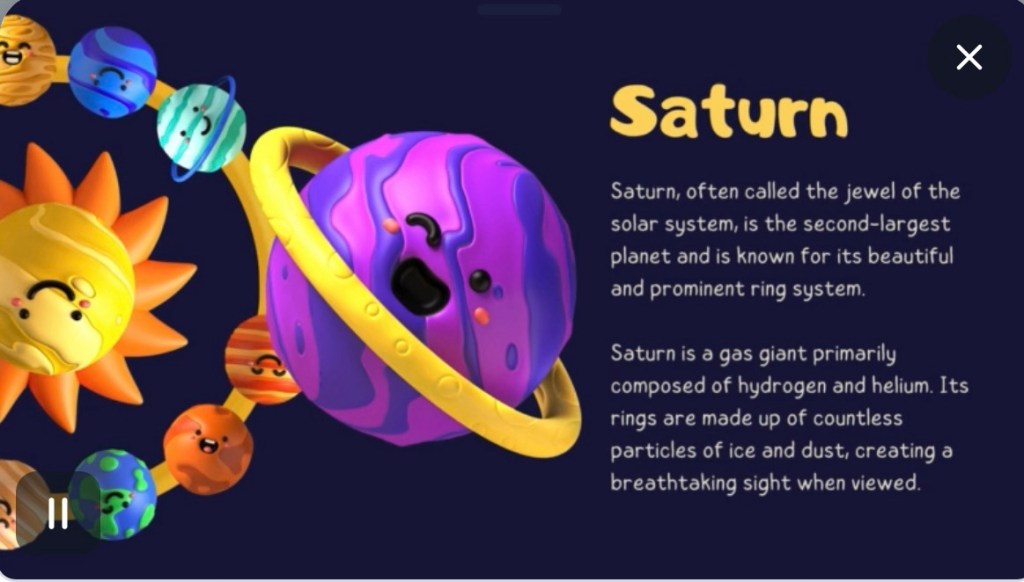
6. Saturn – Known for its beautiful ring system made of ice and rock.
7. Uranus – An ice giant that rotates on its side, giving it unique seasons.
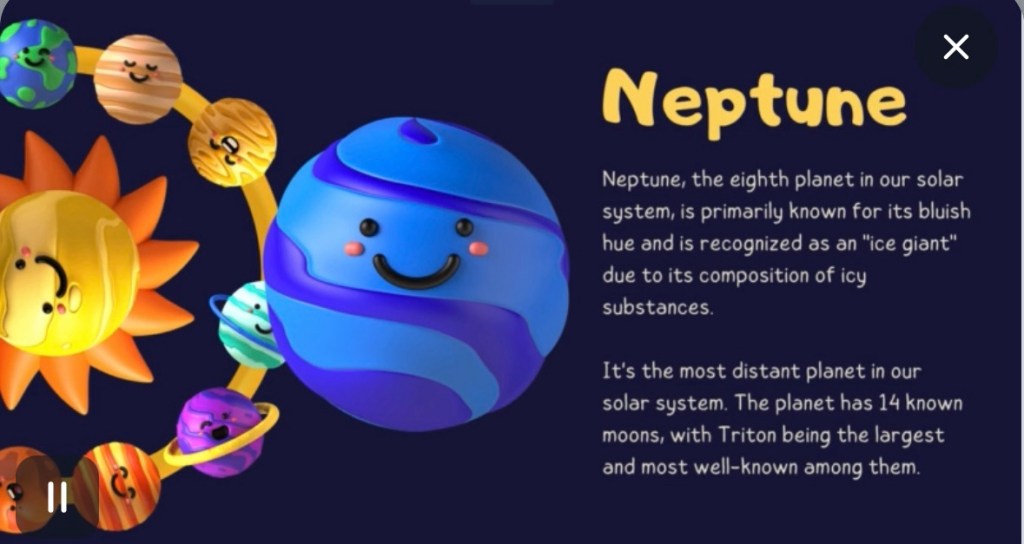
8. Neptune – The farthest planet, known for its strong winds and deep blue color.
SOLAR SYSTEM


The human body
“The human body is made up of many organs and systems that work together. From the brain that controls thoughts to the heart that pumps blood, the lungs that bring oxygen, the digestive system that processes food, and the skeleton and muscles that provide movement and support—each part plays an important role in keeping us alive and healthy.”

The human body
The human body is one of the most fascinating and complex creations in the world. It is made up of trillions of cells, which are the basic building blocks of life. These cells join together to form tissues, organs, and organ systems that allow the body to function properly. Every part of the human body has an important role to play, and all of them work together like pieces of a machine to keep us alive and healthy.
One of the most important parts of the body is the brain. It controls our thoughts, emotions, memory, and movements. The brain sends and receives signals through the nervous system, helping us respond to everything that happens around us. Without the brain, the body cannot function.
Another vital organ is the heart. The heart works nonstop, pumping blood throughout the body. Blood carries oxygen and nutrients to all the cells and removes waste products like carbon dioxide. Along with the heart, the lungs play an essential role. They bring oxygen into the body when we breathe and release carbon dioxide when we exhale. Together, the heart and lungs keep us alive by making sure our blood is rich in oxygen.
The digestive system is also very important. It includes the stomach, intestines, liver, and other organs. Its main job is to break down the food we eat into nutrients that the body can use for energy, growth, and repair. The intestines absorb these nutrients, while the liver helps filter and process them. Waste from the food is removed from the body through the bladder and intestines.
Our bones and muscles give us shape, strength, and the ability to move. The skeleton is like a strong framework that supports the body, while muscles are attached to bones and help us move when they contract and relax. The spine is especially important because it protects the spinal cord, which connects the brain to the rest of the body.
The skin is the body’s largest organ. It acts as a shield, protecting us from germs, sunlight, and injuries. It also helps control body temperature and allows us to feel touch, heat, and cold. Along with the skin, the body has an immune system that fights off infections and keeps us safe from diseases.
Another important part of the body is the kidneys. These bean-shaped organs filter waste and excess water from the blood to make urine. This process helps maintain a healthy balance of fluids and minerals in the body.
The human body is not only strong but also adaptable. It can heal itself when injured, fight against harmful bacteria, and adjust to different environments. However, it also needs proper care. Eating healthy food, drinking enough water, getting exercise, and sleeping well are all necessary to keep the body in good condition.
In conclusion, the human body is a remarkable system made up of many parts that all work together. From the brain and heart to the bones and skin, every organ and system has an important function. By taking care of our bodies, we can stay healthy, active, and able to enjoy life to the fullest.
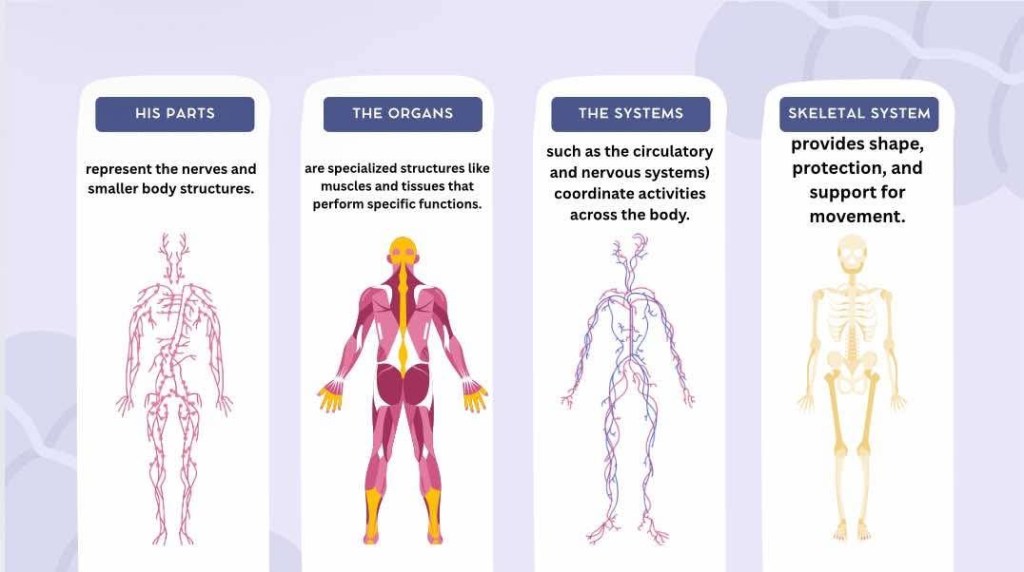
“The human body is made up of different parts, organs, and systems that work together. From the nerves and muscles to the circulatory and skeletal systems, each plays a vital role in giving us strength, protection, coordination, and movement.”
what red blood cell
understanding human body
The human body is made up of trillions of tiny living units called cells, and each one plays a vital role in keeping us alive. Think of cells as the building blocks of life they’re the smallest structural and functional units of our body. From the tips of your hair to the muscles in your legs, every tissue and organ is built from these microscopic wonders.
What makes cells fascinating is their diversity. While they all share common features like a nucleus (the “control center”), cytoplasm (the fluid that holds everything together), and a cell membrane (the protective outer layer) they’re not all the same. Different types of cells have specialized jobs. For example:
Red blood cells carry oxygen throughout the body.
Nerve cells (neurons) transmit electrical signals that allow you to think, feel, and move.
Muscle cells contract to help your body move and maintain posture.
Skin cells form protective layers against the outside world.
Even though they are small, cells are constantly working. They take in nutrients, produce energy, get rid of waste, and repair themselves when damaged. Some cells can live for years, while others, like many skin cells, live only a few weeks before being replaced.
Altogether, your body has more than 200 different types of cells, and they all coordinate like members of a massive orchestra. When they work in harmony, you stay healthy. But when cells are damaged or don’t function properly, it can lead to disease. That’s why studying cells is one of the most important areas of science it helps us understand how the body works and how we can treat illnesses.
It’s amazing to think that something so small, invisible to the naked eye, is the reason we can walk, breathe, and live every single day. Cells might be tiny, but they are truly powerful.
Every step of this process shows how wonderfully designed our bodies are transforming every bite we eat into energy, strength, and growth. 💪🍎 The digestive system is not just about eating it’s about fueling life itself. 🌿🔥
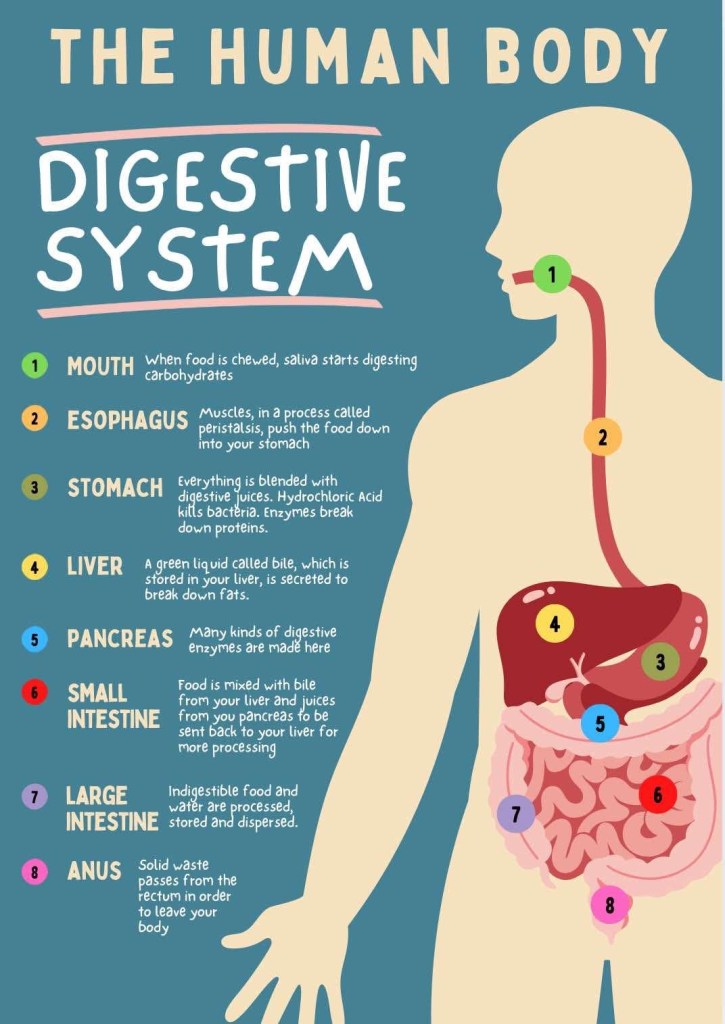
The digestive system is one of the most fascinating and important systems in the human body it works nonstop to make sure our body gets the energy and nutrients it needs to survive and stay healthy. 🧍♂️✨ It all begins in the mouth
(1), where food is chewed and saliva starts breaking down carbohydrates. From there, food travels through the esophagus
(2), pushed down by muscular movements called peristalsis. Once it reaches the stomach
(3), powerful acids and enzymes blend everything, killing bacteria and breaking down proteins. The liver
(4) produces bile, which is vital in breaking down fats, while the pancreas
(5) produces digestive enzymes to further assist digestion. In the small intestine
(6), food mixes with bile and enzymes, allowing nutrients to be absorbed into the bloodstream. Next, the large intestine
(7) processes any leftover indigestible food and absorbs water, forming solid waste. Finally, the journey ends at the anus
(8), where waste exits the body.
Types of cells in the body
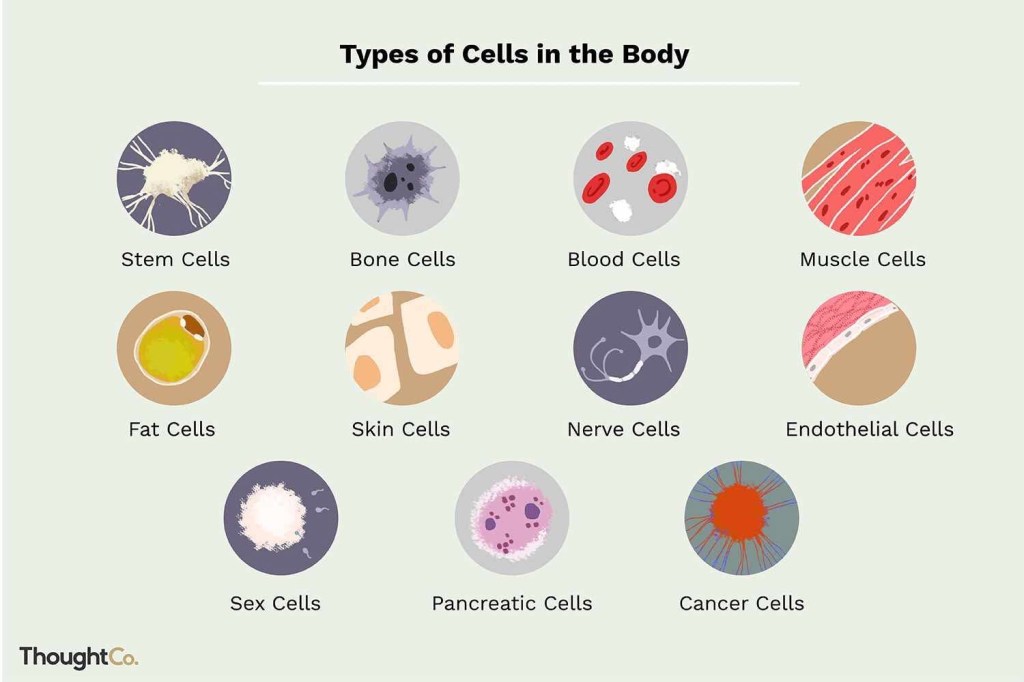
This image shows different types of cells in the human body. Each type of cell has a special role that helps the body work properly. Here’s a simple explanation of each:
Stem Cells – These are the “master cells” of the body. They can develop into many different types of cells (like muscle, nerve, or blood cells) and help with growth and repair.
Bone Cells – These form and maintain bones. They help in bone growth, repair, and keeping bones strong.
Blood Cells – These include red blood cells (carry oxygen), white blood cells (fight infections), and platelets (help blood clot).
Muscle Cells – These make up muscles. They contract and relax, allowing movement of the body and organs.
Fat Cells (Adipocytes) – These store energy in the form of fat. They also provide cushioning and insulation for the body.
Skin Cells – These form the outer covering of the body, protecting us from injury, germs, and dehydration.
Nerve Cells (Neurons) – These carry messages (electrical signals) between the brain, spinal cord, and the rest of the body.
Endothelial Cells – These line the inside of blood vessels and help control the flow of substances between the blood and tissues.
Sex Cells (Gametes) – Sperm cells (male) and egg cells (female). They are needed for reproduction.
Pancreatic Cells – Found in the pancreas, they produce hormones like insulin and enzymes to help digest food.
Cancer Cells – These are abnormal cells that grow and divide uncontrollably, disrupting normal body functions.
👉 In short: The body is made up of specialized cells, each with a unique function, and all of them work together to keep us alive and healthy.
Would you like me to also explain how these cells are connected or work together as a system?
Human body cell
The theory of plate tectonics is supported by a wide range of geological, biological, and geophysical evidence. Together, these findings prove that the Earth’s outer shell is broken into plates that move and interact over time.
- Fit of Continents
One of the earliest clues came from the observation that the shapes of continents seem to fit together like puzzle pieces. For example, the east coast of South America and the west coast of Africa align almost perfectly. This suggests that the continents were once joined together in a single large landmass called Pangaea, which later split apart as the plates moved.
- Fossil Evidence
Similar fossils of plants and animals have been found on continents that are now separated by vast oceans. For instance:
Fossils of the reptile Mesosaurus are found in both South America and Africa.
Fossils of the plant Glossopteris are found in South America, Africa, India, and Antarctica.
It would have been impossible for these species to cross such wide oceans, so the continents must have once been connected.
- Rock and Mountain Correlation
Geological structures provide another line of evidence. Mountain ranges and rock formations on different continents match when the continents are placed back together. A classic example is the Appalachian Mountains in North America, which align with mountains in Scotland and Norway. This shows that these ranges were once part of a single chain before the Atlantic Ocean opened up between them.
- Seafloor Spreading and Ocean Floor Evidence
Studies of the ocean floor revealed that new crust is being created at mid-ocean ridges. As magma rises and solidifies, it pushes older crust away, causing the seafloor to spread. Magnetic patterns in the rocks on either side of ridges show symmetrical “stripes” of normal and reversed polarity, created as Earth’s magnetic field flipped over millions of years. These patterns prove that new crust is continually being formed and pushed outward.
- Distribution of Earthquakes and Volcanoes
Most earthquakes and volcanoes occur in narrow belts around the world, especially along plate boundaries. For example, the Pacific Ring of Fire is an area of intense seismic and volcanic activity that traces the edges of several tectonic plates. This distribution matches perfectly with the theory that plates interact at their edges, causing these natural events.
- Paleoclimatic Evidence
Evidence of past climates also supports plate movement. For example, glacial deposits and striations (scratch marks from ice movement) are found in present-day tropical regions like India and South Africa. This indicates that these continents were once located closer to the South Pole before drifting to their current positions.
✅ Conclusion:
The combination of the fit of continents, fossil distribution, matching rock formations, seafloor spreading, earthquake and volcano patterns, and paleoclimatic evidence all strongly support the plate tectonic theory. These different lines of evidence together give us a clear picture of how Earth’s surface has been shaped and continues to change over time.
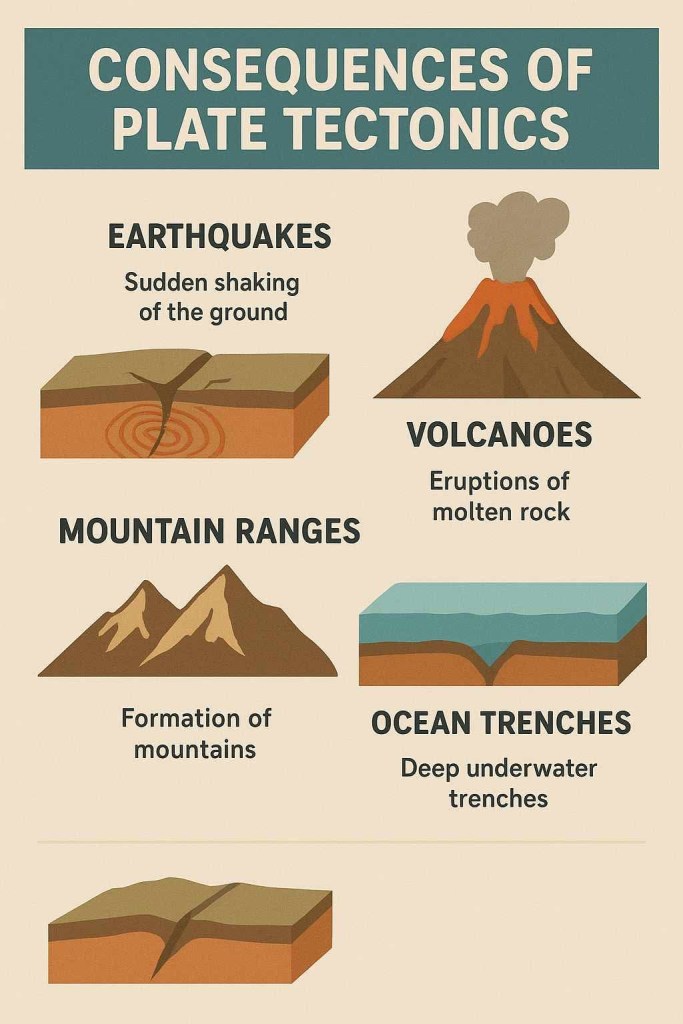
- Earthquakes 🌀
Happen when plates suddenly slip past each other along faults.
The built-up stress is released as seismic waves, shaking the ground.
Most common at transform boundaries (like the San Andreas Fault).
- Volcanoes 🌋
Form when molten rock (magma) rises to the surface.
Occur mainly at convergent boundaries (subduction zones) and divergent boundaries (mid-ocean ridges).
Example: The Pacific “Ring of Fire.”
- Mountain Ranges ⛰️
Created when two continental plates collide and push land upward.
Example: The Himalayas formed when the Indian Plate collided with the Eurasian Plate.
- Ocean Trenches 🌊
Very deep, narrow valleys in the ocean floor.
Form at convergent boundaries where an oceanic plate is forced beneath another plate (subduction).
Example: The Mariana Trench, the deepest part of Earth’s oceans.
The Continental Drift Theory was proposed by Alfred Wegener in 1912. He suggested that the continents we see today were once joined together in a single supercontinent called Pangaea about 200–250 million years ago. Over millions of years, Pangaea slowly broke apart, and the pieces (continents) drifted to their present positions.
Key Evidence Wegener used:
Fossils: Same plant and animal fossils found on continents now separated by oceans (e.g., Mesosaurus in South America & Africa).
Geological Features: Similar rock formations and mountain ranges on different continents.
Climate Clues: Evidence of glacial deposits in places that are now tropical.
Although Wegener’s idea was initially rejected (because he couldn’t explain how continents moved), later discoveries in plate tectonics provided the mechanism — movement of Earth’s lithospheric plates on the semi-fluid mantle.
👉 In short: Continental Drift explains that continents are slowly moving and were once joined together in a supercontinent called Pangaea.
Evidence of Continental Drift Theory
The Continental Drift Theory was first proposed by Alfred Wegener in 1912. He suggested that all continents were once part of a giant landmass called Pangaea about 200–250 million years ago. Over time, this supercontinent broke apart, and the fragments slowly drifted to their current positions. At first, many scientists rejected Wegener’s theory because he could not explain the actual mechanism of movement, but today we know his evidence was very strong.
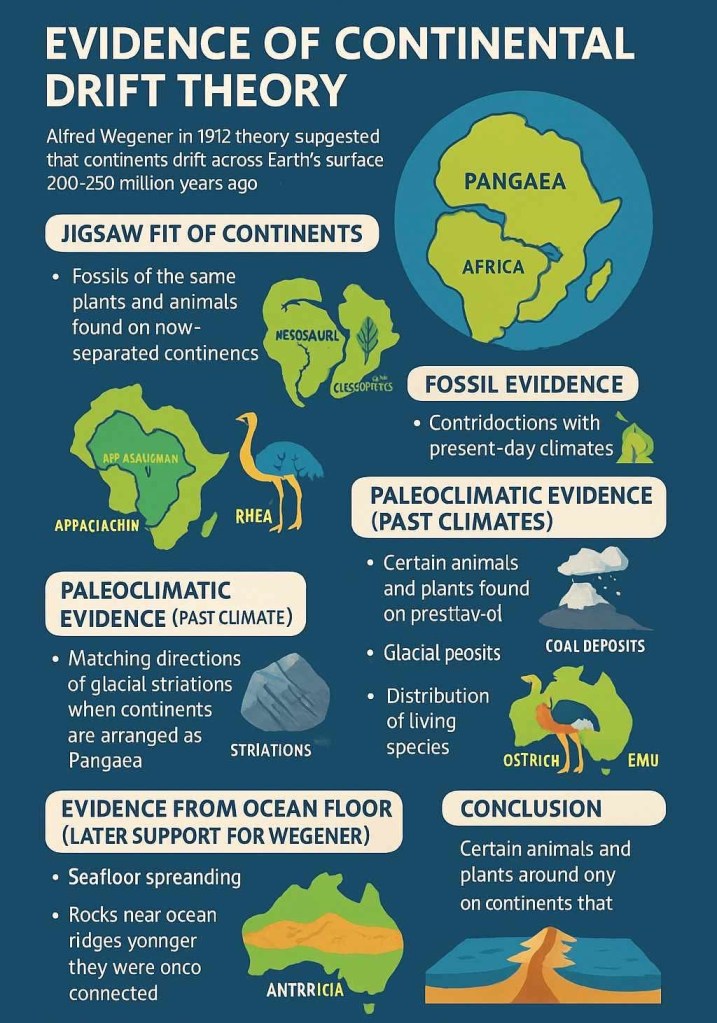
Here are the main pieces of evidence that support continental drift:
- Jigsaw Fit of Continents
The most striking evidence is the way continents appear to fit together like puzzle pieces.
The eastern coastline of South America matches closely with the western coastline of Africa.
Similarly, North America fits with Europe, and India fits into the curve of Asia.
This close fit suggests that the continents were once joined and later drifted apart.
Although erosion and sea level changes have slightly altered coastlines, the overall matching shape remains strong evidence.
- Fossil Evidence
Fossils of the same plants and animals have been discovered on continents that are now separated by wide oceans.
Examples:
Mesosaurus, a freshwater reptile, found in both Brazil (South America) and South Africa. Since it could not have swum across the salty Atlantic Ocean, the continents must once have been joined.
Glossopteris, a fern-like plant, whose fossils are found in Africa, South America, Antarctica, India, and Australia. This shows that these continents were once connected.
Lystrosaurus and Cynognathus, land reptiles, also provide strong proof, as their fossils are distributed across continents that were once linked.
- Similarity of Rocks and Mountain Ranges
Rocks and mountain chains on different continents show striking similarities:
The Appalachian Mountains in eastern North America match with the Caledonian Mountains of Scotland and Scandinavia.
Geological formations in Brazil are similar to those found in West Africa.
Such evidence suggests that these landmasses were once part of the same crustal block before drifting apart.
- Paleoclimatic Evidence (Past Climates)
Wegener also studied ancient climate patterns and found strong contradictions with present-day climates:
Glacial deposits (tillites) are found in present-day warm regions like South Africa, India, South America, and Australia. This shows that these regions were once near the South Pole.
Coal deposits, which form in warm, swampy climates, are found in Antarctica. This proves that Antarctica was once much closer to the equator and had a tropical climate.
These findings indicate that continents must have shifted to different climatic zones over millions of years.
- Glacial Striations and Rock Deposits
Glaciers leave behind scratch marks called striations on rocks.
The direction of these glacial striations on different continents matches perfectly when the continents are put together in the Pangaea arrangement.
For example, glacial deposits in India, Africa, Australia, and South America all point to a common ice sheet, proving they were once joined.
- Distribution of Living Species
Certain animals and plants are found only on continents that were once connected:
For example, the flightless bird Rhea in South America, Ostrich in Africa, and Emu in Australia are closely related species that evolved after the continents drifted apart.
This biogeographical evidence supports the idea that continents separated after species had already spread.
- Evidence from Ocean Floor (Later Support for Wegener)
Wegener lacked a clear mechanism, but later discoveries added strong support:
The study of the Mid-Atlantic Ridge revealed that new crust is formed by seafloor spreading.
Rocks near ocean ridges are younger than those farther away, showing continuous movement of plates.
Although this was discovered after Wegener’s time, it confirmed his theory of drifting continents.
FROM PANGEA TO JURASSIC
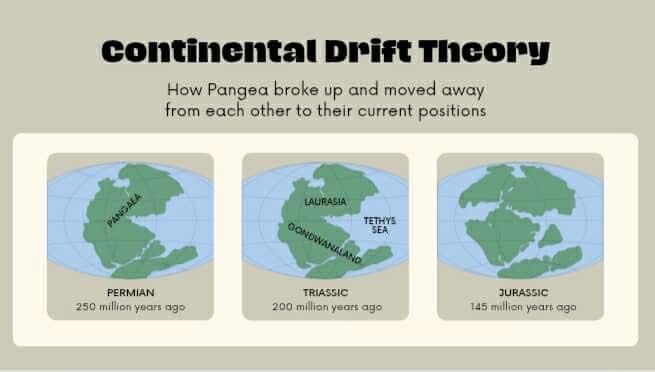
All land was gathered into Pangaea.
The surrounding ocean was called Panthalassa, covering most of the Earth.
Pangaea stretched almost from the North Pole to the South Pole.
Life included early reptiles, amphibians, and forests that produced massive coal deposits we still mine today.
Earth’s climate was generally dry inside the supercontinent because the ocean was far away from many regions.Triassic Period (200 million years ago)
Pangaea began to crack and split into two supercontinents:
Laurasia in the north (future North America, Europe, and Asia).
Gondwanaland in the south (future South America, Africa, Antarctica, Australia, and India).
Between them formed the Tethys Sea.
This was also the time when the first dinosaurs and early mammals appeared.Jurassic Period (145 million years ago)
The continents drifted farther apart.
Gondwanaland started to break into smaller continents.
The early Atlantic Ocean began to open.
Dinosaurs thrived, and lush forests covered much of Earth.
Continental movement created new coastlines and ecosystems, shaping the evolution of life.FROM CRETACROUS TO PRESENT DAY
Cretaceous Period (65 million years ago)
The separation between continents became more distinct.
South America and Africa had completely split.
India broke away from Africa and began drifting north toward Asia, eventually colliding to form the Himalayas.
Australia began moving away from Antarctica.
The Atlantic Ocean widened even more.
This was the time of the last dinosaurs—until a mass extinction event (caused by a massive asteroid impact and volcanic eruptions) wiped them out about 66 million years ago.
Present Day
Continents are in the positions we recognize today: North America, South America, Africa, Europe, Asia, Australia, and Antarctica.
They are not fixed—continents are still drifting at a rate of about 2–5 centimeters per year.
For example, the Atlantic Ocean is expanding because North America and Europe are moving apart.
The Pacific Ocean is shrinking because its ocean floor is being pushed under surrounding plates (subduction).
Earth continues to reshape itself through earthquakes, volcanic eruptions, and mountain-building.A SIMPLE THEN AND NOW COMPARISON
Then (250 million years ago – Pangaea)
Wegener proposed that all continents were once joined as a supercontinent.
His idea was based on evidence like fossils, geology, and climate.
At the time, many scientists rejected him because he couldn’t explain the mechanism of movement.
Now (Present Day – Separated Continents)
We now know Wegener was correct.
Plate tectonics explains that Earth’s outer shell is divided into massive plates that float on the semi-molten mantle.
These plates move slowly due to convection currents inside Earth.
This movement causes earthquakes, volcanic eruptions, and the drifting of continents.
Alfred Wegener
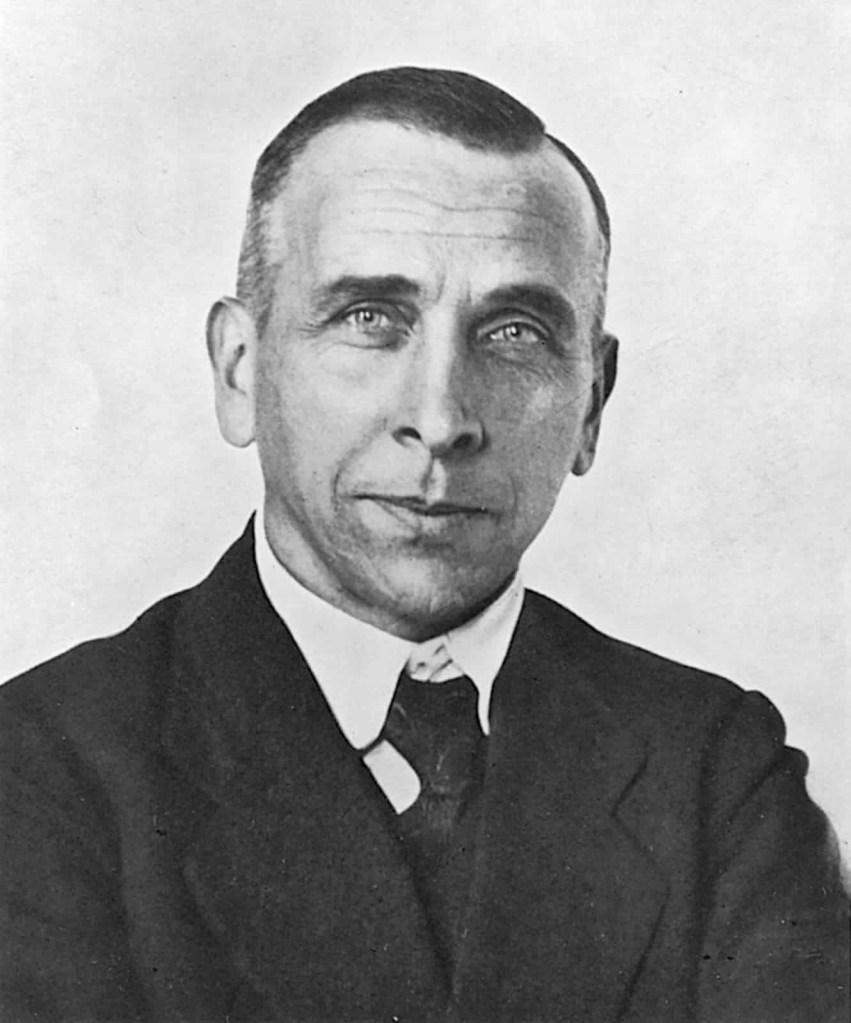
Here’s a breakdown of his theory:
🌍 Continental Drift Theory (1912)
• Main Idea: The continents were once joined together in a single massive landmass called Pangaea (“all Earth”) about 300 million years ago.
• Over time, Pangaea broke apart, and the continents slowly drifted to their current positions.
🔑 Evidence Wegener used:
1. Fit of the Continents
• South America and Africa seemed to fit together like puzzle pieces.
2. Fossil Evidence
• Identical fossils of plants and animals (e.g., Mesosaurus, Glossopteris) were found on widely separated continents.
3. Geological Evidence
• Mountain ranges and rock formations on different continents matched (e.g., Appalachians in North America and Caledonides in Europe).
4. Climatic Evidence
• Evidence of past glaciation was found in places that are now tropical, suggesting they were once closer to the poles.
⚖️ Reception
• At first, Wegener’s idea was not accepted by most scientists because he couldn’t explain how the continents moved.
• The theory gained support in the 1960s with the development of Plate Tectonics, which explained movement through seafloor spreading and convection currents in the mantle.
🌍Continental Drift Theory🌍
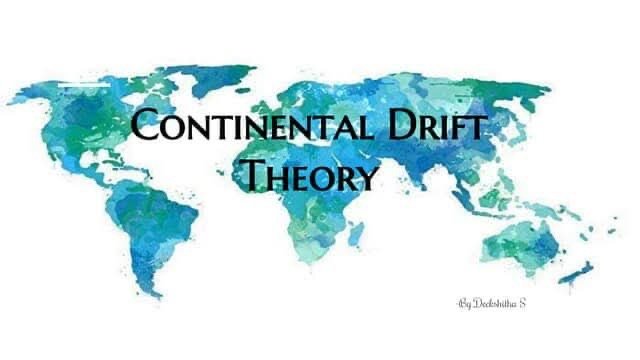
Evidence for continental drift includes the “jigsaw puzzle fit” of continents like South America and Africa, the discovery of similar fossils across distant continents, matching rock formations, and evidence of past climates such as glacial deposits found in now-tropical areas.
The movement of continents continues even today, reshaping Earth’s surface gradually through earthquakes, volcanic activity, and the formation of mountains. Continental drift not only explains the past but also helps predict the future changes in our planet’s geography. 🌏✨
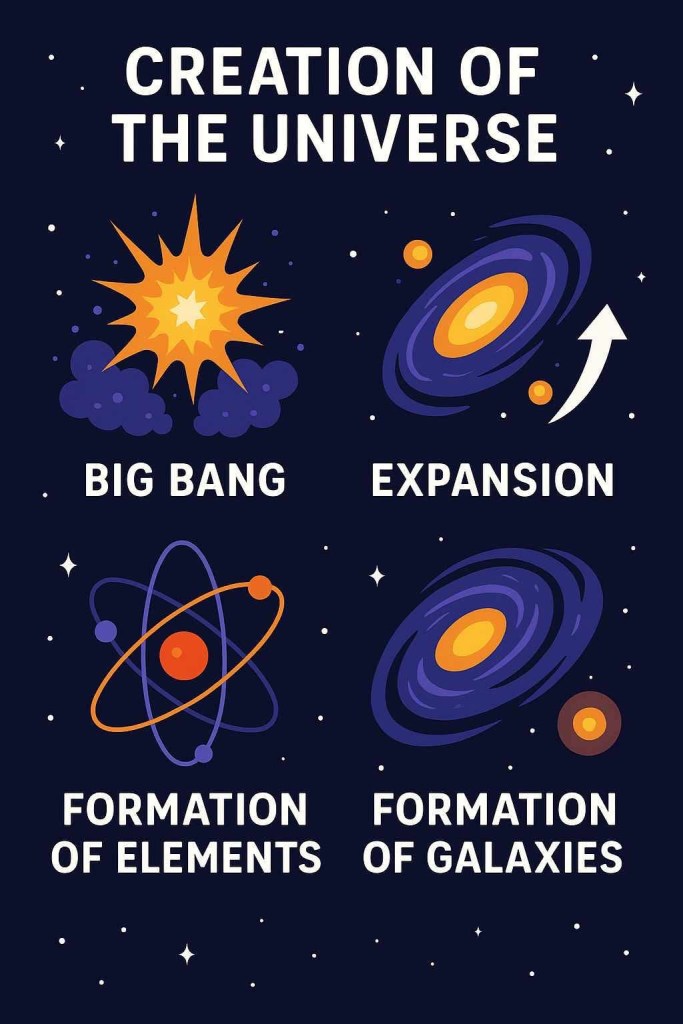
Origin Of The Universe
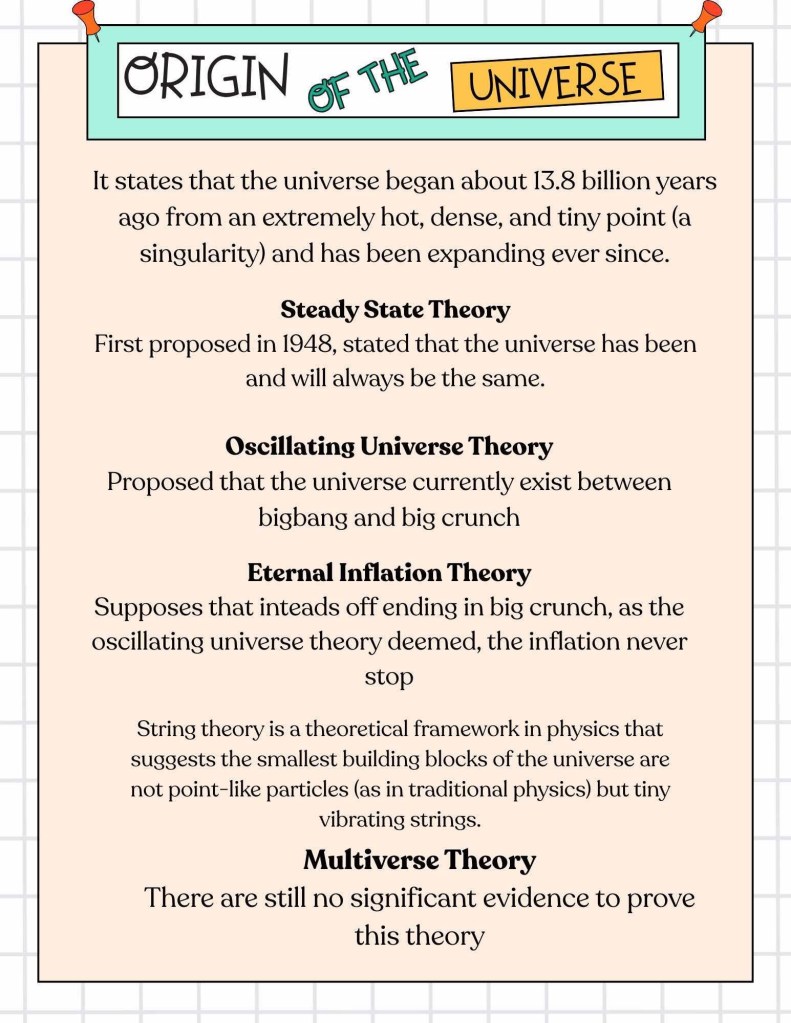
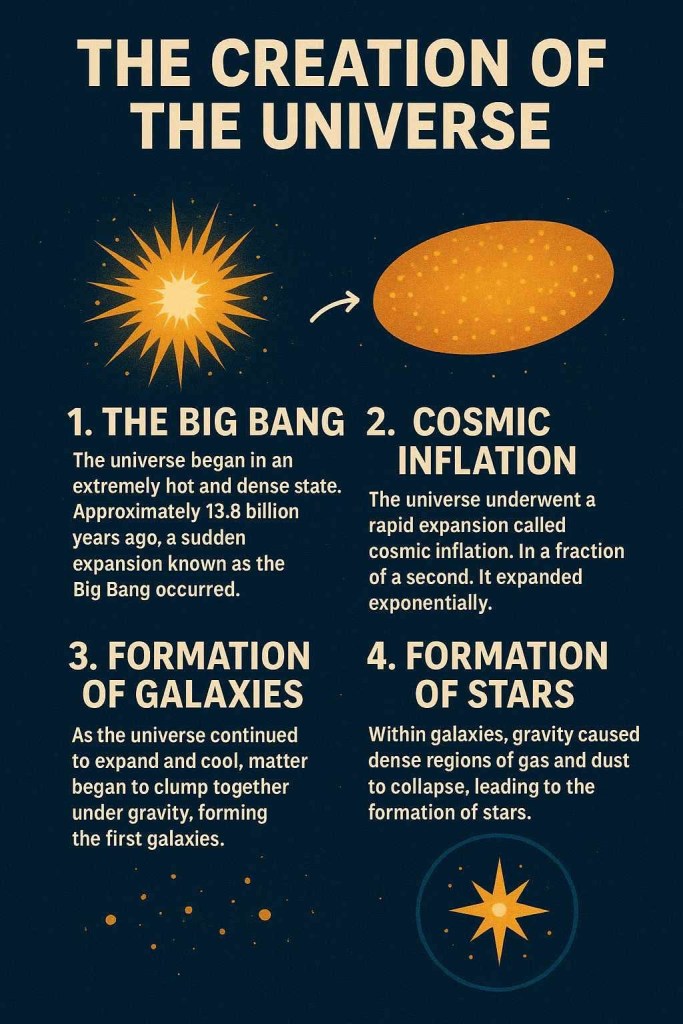
🌌✨ The Creation of the Universe ✨🌌
Discover the Future with Us!
WELCOME TO SCIENCE AND DISCOVERY!!!!!
WE are grade 11 stem Newton
Curiosity sparks innovation—and at SCIENCE AND DISCOVERY, we bring you the latest breakthroughs, mind-expanding research, and awe-inspiring stories from the world of science and technology. Inspiring our learners by exploring exciting topic about science:
ANATOMY
STRUCTURE OF THE ATMOSPHERE
THE SOLAR SYSTES
Our mission is to inspire minds, support scientific literacy, inspiring learners, and promote innovation for a better future.
Join us as we uncover groundbreaking studies, explain complex ideas in simple terms, and celebrate the power of human curiosity. Together, we’ll explore the questions that push the boundaries of knowledge and ignite a passion for discovery.
“From the Big Bang to galaxies” here is the story of our universe’s creation.
 ScienceAndDiscovery